sama cybersecurity framework

SAMA Cybersecurity Framework: Domains and Maturity Levels

Huzaifa.Hamza Article 9 min read

If your organization is regulated by the Saudi Central Bank (SAMA), cybersecurity is not only an IT matter. It is a supervisory requirement, reviewed and audited by the regulator.

The SAMA cybersecurity framework sets the security baseline for financial institutions in Saudi Arabia. It defines what controls must exist, who is accountable for them, and how mature they need to be.

This guide explains who the SAMA cybersecurity framework applies to, its four domains, its six maturity levels, and practical steps to prepare for an assessment.

What Is the SAMA Cybersecurity Framework?

The SAMA cybersecurity framework, officially titled the SAMA Cyber Security Framework, is a set of cybersecurity requirements issued by SAMA for the organizations it regulates. Version 1.0 was published in May 2017.

The framework has three stated objectives:

To create a common approach to cybersecurity across member organizations

To reach an appropriate maturity level for cybersecurity controls

To make sure cybersecurity risks are properly managed

It is based on SAMA’s own requirements and on recognized industry standards, which the document lists as NIST, ISF, ISO, BASEL, and PCI.

Who Must Comply

The framework applies to SAMA’s "Member Organizations," which include:

Banks operating in Saudi Arabia

Insurance and reinsurance companies

Financing companies

Credit bureaus

Financial market infrastructure

All domains apply to the banking sector. A small number of subdomains apply differently to non-banking members, such as those covering payment systems and electronic banking services.

How Compliance Is Assessed

Member organizations complete a periodic self-assessment using a questionnaire.

SAMA reviews and audits those self-assessments to determine compliance and maturity.

The full current text is maintained on the SAMA Rulebook.

The Four Domains of the SAMA Cybersecurity Framework

The SAMA cybersecurity framework organizes its controls into four main domains, each split into subdomains.

1. Cyber Security Leadership and Governance

This domain sets who is responsible and how decisions are made. The board holds ultimate responsibility and may delegate to a cybersecurity committee.

Subdomains:

3.1.1 Cyber Security Governance

3.1.2 Cyber Security Strategy

3.1.3 Cyber Security Policy

3.1.4 Cyber Security Roles and Responsibilities

3.1.5 Cyber Security in Project Management

3.1.6 Cyber Security Awareness

3.1.7 Cyber Security Training

Key Governance Roles

Board: holds ultimate responsibility, allocates budget, and endorses the strategy and policy.

Cybersecurity committee: headed by an independent senior manager from a control function, meeting at least quarterly.

CISO: a full-time senior manager who must be a Saudi national, appointed with SAMA’s no-objection, and reporting to the CEO or managing director.

Internal audit: performs cybersecurity audits.

2. Cyber Security Risk Management and Compliance

This domain covers how risks are found, analyzed, treated, and monitored, and how compliance is checked.

Subdomains:

3.2.1 Cyber Security Risk Management (identification, analysis, response, and monitoring)

3.2.2 Regulatory Compliance

3.2.3 Compliance with (inter)national industry standards

3.2.4 Cyber Security Review

3.2.5 Cyber Security Audits

Under 3.2.3, organizations that process cardholder data or use SWIFT services must also meet PCI and SWIFT security requirements. This is where the framework meets other standards such as ISO 27001.

3. Cyber Security Operations and Technology

This is the largest domain. It covers the day-to-day controls that protect systems and data.

Subdomains:

3.3.1 Human Resources

3.3.2 Physical Security

3.3.3 Asset Management

3.3.4 Cyber Security Architecture

3.3.5 Identity and Access Management

3.3.6 Application Security

3.3.7 Change Management

3.3.8 Infrastructure Security

3.3.9 Cryptography

3.3.10 Bring Your Own Device (BYOD)

3.3.11 Secure Disposal of Information Assets

3.3.12 Payment Systems

3.3.13 Electronic Banking Services

3.3.14 Cyber Security Event Management

3.3.15 Cyber Security Incident Management

3.3.16 Threat Management

3.3.17 Vulnerability Management

Incident management (3.3.15) needs a tested, documented process. Our guide to building an incident response plan covers the practical side.

4. Third Party Cyber Security

The framework expects third parties to protect information at the same level as the organization itself.

Subdomains:

3.4.1 Contract and Vendor Management

3.4.2 Outsourcing

3.4.3 Cloud Computing

The Six Maturity Levels of the SAMA Cybersecurity Framework

The SAMA cybersecurity framework uses a maturity model from level 0 to level 5. Each level describes how well controls are defined, applied, and measured.

Level 0: Non-existent

Controls are absent, and there is little or no awareness of the risk.

Level 1: Ad-hoc

Controls are partly defined and applied inconsistently, often varying by department or owner.

Level 2: Repeatable but Informal

Practices are repeated but not written down, and their design is not formally approved.

Level 3: Structured and Formalized

Controls are defined, approved, and implemented formally, with policies, procedures, and KPIs that are monitored.

Level 4: Managed and Measurable

Control effectiveness is measured regularly using key risk indicators, and the results drive improvements.

Level 5: Adaptive

Controls follow a continuous improvement plan, are integrated with enterprise risk management, and are benchmarked against peers and the sector.

Why Level 3 Is the Minimum

SAMA states that member organizations should operate at maturity level 3 or higher. To reach levels 3, 4, or 5, an organization must also meet all the criteria of the levels below.

In practice, level 3 means you can show documents, approvals, and monitoring for every control. Good intentions and informal habits are not enough.

How the SAMA Cybersecurity Framework Relates to Other Standards

Many organizations already work with several frameworks at once. The SAMA cybersecurity framework was designed with that in mind.

It draws on NIST, ISF, ISO, BASEL, and PCI, so controls often map to existing work.

Subdomain 3.2.3 explicitly requires compliance with relevant industry standards.

One control can produce evidence for several frameworks if it is documented well.

For a wider view of the regional landscape, see our guide to cybersecurity compliance in the GCC.

How to Prepare for a SAMA Assessment

A structured approach saves time and avoids last-minute document hunts.

Confirm scope. Identify which subdomains apply to your type of institution.

Run a gap assessment. Score each control against the six maturity levels.

Prioritize gaps below level 3. These are the urgent items.

Assign owners. Every control needs a named person and a deadline.

Document everything. Policies, procedures, approvals, and evidence of operation.

Define KPIs and KRIs. These are needed to show level 3 and to move toward level 4.

Brief the board and committee. Governance evidence is part of the assessment.

Test before the review. Run an internal audit or mock assessment.

Evidence Worth Preparing

Board-approved cybersecurity strategy and policy

Committee charter and meeting minutes

Risk register with treatment plans

Access reviews and privileged account lists

Incident and vulnerability records

Awareness and training plans with results

Common Mistakes With the SAMA Cybersecurity Framework

These gaps slow many organizations down on the way to level 3.

Policies without evidence. A signed policy is level 3 only if you can show it is applied and monitored.

Treating it as an IT project. The SAMA cybersecurity framework places ultimate responsibility on the board, not the IT department.

Ignoring third parties. Vendors, outsourcing partners, and cloud providers must meet the same level of protection.

No metrics. Without KPIs and KRIs, you cannot show level 3 monitoring or move toward level 4.

One-off awareness campaigns. The framework expects awareness to run periodically through the year and to be evaluated.

Last-minute preparation. Evidence collected the week before a review is usually incomplete.

Fixing these early makes every later step of the SAMA cybersecurity framework easier.

Where Awareness and Training Fit

Two subdomains focus directly on people.

3.1.6 Cyber Security Awareness

The framework expects awareness programs that:

Reach staff, third parties, and customers

Are tailored to each audience

Use multiple channels

Run periodically throughout the year

Cover emerging threats such as spear-phishing

Are evaluated for effectiveness

3.1.7 Cyber Security Training

Specialized training is required for key roles, including cybersecurity staff, people who develop or maintain information assets, and staff who perform risk assessments.

The phrase "evaluated for effectiveness" matters. Completion records show that training happened, not that it worked. You need behavior data, such as phishing simulation results, that shows improvement over time.

Conclusion

The SAMA cybersecurity framework gives financial institutions in Saudi Arabia a clear structure: four domains, defined subdomains, and a maturity model with level 3 as the minimum.

Treat it as a working program, not a yearly exercise. Assign owners, document controls, measure them, and keep evidence ready. Awareness and training deserve special attention, because they must be shown to work, not just to exist.

Meet SAMA Awareness Requirements With AwareX

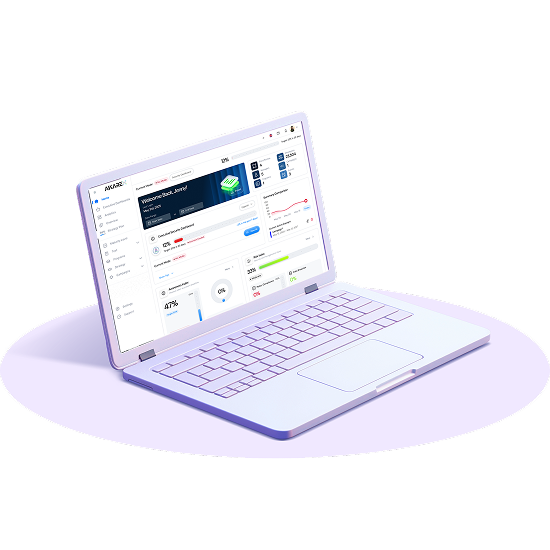
AwareX helps financial institutions run awareness programs that SAMA expects to be measured. It combines phishing simulations, structured training, and a Human Risk Score for every employee, with built-in tracking for SAMA and NCA requirements and reports you can export for auditors.

Explore AwareX or contact the CyberX team to map your awareness program to the framework. Learn more about CyberX on our home page.

Frequently Asked Questions

What is the SAMA cybersecurity framework?

It is the cybersecurity framework issued by the Saudi Central Bank for the financial institutions it regulates. It defines required controls across four domains and a maturity model from level 0 to 5.

Who must comply with the SAMA cybersecurity framework?

Banks operating in Saudi Arabia, insurance and reinsurance companies, financing companies, credit bureaus, and financial market infrastructure.

What are the four domains of SAMA CSF?

Cyber Security Leadership and Governance; Cyber Security Risk Management and Compliance; Cyber Security Operations and Technology; and Third Party Cyber Security.

What maturity level does SAMA require?

Member organizations should operate at maturity level 3 (Structured and Formalized) or higher.

How is compliance assessed?

Organizations complete periodic self-assessments, which SAMA reviews and audits to determine compliance and maturity.

AwareX

Train your staff to stop cyber attacks

  • Ready-made Arabic awareness content
  • Realistic phishing simulations
  • Reports ready for NCA requirements
Book a demo

Talk to the CyberX team

Tell us about your organization and we will suggest the right awareness program within one business day.

    By clicking submit below, you consent to allow CyberX to store and process the personal information submitted above to provide you the content requested.
    Languages: