human risk management

Human Risk Management: Measuring the Risk Behind Each Click

Huzaifa.Hamza Article 9 min read

Ask most security teams how their awareness program is going and you will hear a completion rate. Ninety-four percent of staff finished the annual module. That number tells you who attended. It tells you nothing about who will click the next fake invoice.

Human risk management closes that gap. Instead of counting finished courses, it measures how people actually behave, scores the risk that behavior creates, and directs effort to the people and habits that matter most.

This guide explains what human risk management is, what it measures, how to build a risk score, and how to bring that score down in 90 days.

What Is Human Risk Management?

Human risk management (HRM) is the practice of identifying, measuring, and reducing the security risk created by employee behavior. It treats people the way security teams already treat systems: as assets with exposure, signals, and controls.

The goal is not to blame staff. It is to know where the real risk sits, so you can fix it before an attacker finds it.

How It Differs From Security Awareness Training

Training is one input. Human risk management is the full loop around it.

Training asks: did the employee complete the course?

HRM asks: did the employee’s behavior change, and is the organization safer because of it?

Training is periodic: usually once or twice a year.

HRM is continuous: behavior data flows in every week.

Training is the same for everyone. HRM targets the people with the highest exposure.

If you want the training side done well, our guide to security awareness training covers program design in detail.

Why Completion Rates Are Not a Risk Metric

A completion rate measures compliance with a task. It does not measure risk. An employee can pass a quiz on Monday and approve a fraudulent payment on Thursday.

Behavior data is harder to collect, but it is the only data that predicts incidents.

Why Human Risk Management Matters Now

Attackers have learned that people are often easier to exploit than patched servers. Verizon’s Data Breach Investigations Report notes that the most frequent breach causes heavily involve the human element, including social engineering, phishing, and stolen credentials. The 2026 edition also reports click rates 40% higher on mobile devices, which is where much of today’s work happens.

We explore why people remain such a common entry point in our article on the human factor as a primary vulnerability.

What Saudi Regulators Expect

In Saudi Arabia, awareness is a regulatory expectation, not an optional extra.

The SAMA Cyber Security Framework has dedicated subdomains for awareness (3.1.6) and training (3.1.7).

SAMA requires awareness programs to be evaluated for effectiveness, not just delivered.

Auditors increasingly ask for evidence of behavior change, not attendance lists.

Human risk management gives you that evidence.

The Behaviors Human Risk Management Measures

A useful program tracks a small set of behaviors that link directly to incidents. Start with these.

Phishing Clicks vs. Phishing Reports

Click rate alone is a weak signal. The report rate is often more important.

Click rate: how many people opened a simulated malicious link.

Credential submission rate: how many went further and typed a password.

Report rate: how many flagged the message to security.

Time to first report: how quickly the first person raised the alarm.

An organization where 8% click but 60% report is in better shape than one where 4% click and nobody reports.

Credential and MFA Habits

Password reuse found in breach data

Users who have not enrolled in multi-factor authentication

Users who approve unexpected MFA push requests

Shared accounts and passwords sent over chat

Data Handling and Policy Breaches

Sensitive files sent to personal email

Uploads to unapproved cloud storage or AI tools

Repeated data loss prevention (DLP) alerts

Unacknowledged security policies

Access and Privilege

Not every employee carries the same risk. A finance manager who can release payments, or an IT admin with domain rights, has far more impact if compromised. Human risk management weighs behavior against access. This is also the core of insider threat programs, where access and behavior are read together.

How to Build a Human Risk Score

A human risk score combines behavior signals into a single number per person, team, and department. Keep the model simple enough to explain to managers.

Data Sources

Phishing simulation results (clicks, submissions, reports)

Training and assessment results

Identity data (MFA status, privileged accounts)

Security tool alerts (DLP, endpoint, email gateway)

Policy acknowledgement records

Weighting by Role and Access

Score each behavior, then multiply by exposure. A practical approach:

Behavior score: how risky the person’s recent actions were

Exposure score: how much damage their access could cause

Trend: whether the score is improving or getting worse

High-Risk Groups to Watch First

Executives and their assistants (frequent targets of impersonation)

Finance and procurement teams (payment fraud)

IT and system administrators (privileged access)

HR and recruitment (constant inbound attachments)

New joiners in their first 90 days

Keep It Fair and Transparent

Tell employees what you measure and why. Use scores to target help, not to punish. A score that feels like surveillance will damage the trust the program depends on.

Bringing Risk Down: A 90-Day Human Risk Management Plan

Here is a practical rollout for a mid-size organization.

Days 1–15: Baseline. Run a phishing simulation across all staff and pull MFA and policy data. Record the starting score.

Days 16–30: Segment. Identify the top 10% riskiest users and the highest-exposure roles.

Days 31–60: Target. Assign short, role-specific training to those groups. Trigger micro-lessons automatically after a failed simulation.

Days 61–75: Fix the process. Where many people fail the same test, the problem is often the process, not the people. Add payment call-backs, simplify reporting, tighten MFA.

Days 76–90: Re-measure. Run a second simulation of similar difficulty and compare scores by department.

Who Owns Human Risk Management?

Human risk sits between several teams, so ownership has to be clear from day one.

Security team: runs simulations, collects behavior data, and maintains the scoring model.

HR: supports onboarding training, role changes, and fair handling of repeat failures.

Line managers: see their team’s score and help close gaps in their own processes.

Internal audit and compliance: review the evidence and check it matches regulatory requirements.

Leadership: sets the target risk level and funds the fixes.

A Simple Example

Imagine the finance team scores highest after the baseline test. Several people entered credentials on a fake payment portal. Nobody reported the email.

Instead of repeating a generic course, the team gets a 10-minute lesson on payment fraud. Finance also adds a phone call-back rule for any change to supplier bank details. One month later, the next simulation shows fewer submissions and the first reports arriving within minutes. That change in behavior, not a certificate, is the result you can show an auditor.

Common Human Risk Management Mistakes

Measuring only click rate and ignoring reporting

Running the same easy template every quarter

Naming and shaming people who fail

Treating every employee the same regardless of access

Collecting data but never changing a process because of it

Reporting to leadership once a year instead of every month

Metrics Leadership Should See

Executives do not need raw logs. They need a short monthly view:

Overall human risk score and trend

Report rate vs. click rate

Risk by department and by high-exposure role

Percentage of staff with MFA enabled

Repeat failures and how many improved after training

NIST SP 800-50 Rev. 1, published in 2024, supports this approach: it frames learning programs as a driver of behavior change within risk management and recommends regular metrics and evaluation.

Conclusion

Human risk management moves security awareness from attendance to evidence. You measure real behavior, weigh it against access, and spend effort where risk is highest.

Start small. Pick three behaviors, build a simple score, and re-measure after 90 days. The trend line is what proves the program works.

Measure and Reduce Human Risk With AwareX

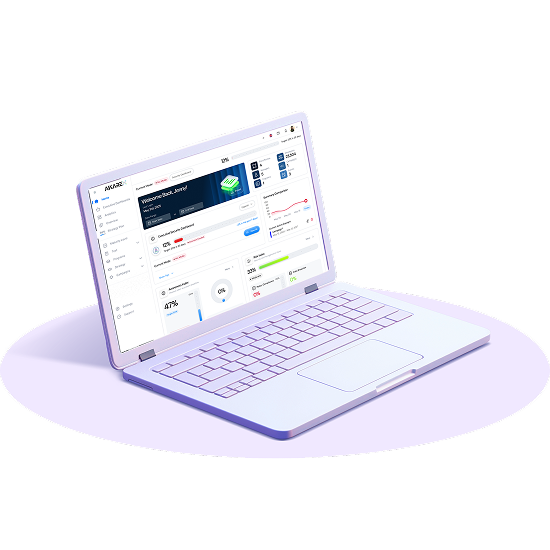
AwareX gives every employee a Human Risk Score built from phishing simulations, training results, and policy evidence. Repeat failures trigger personalized training automatically, and the executive dashboard shows risk by department in Arabic and English.

It also tracks evidence for NCA and SAMA requirements in one place. Explore AwareX or contact the CyberX team to book a demo. You can also see our full approach on the CyberX home page.

Frequently Asked Questions

What is human risk management in cybersecurity?

It is the practice of measuring and reducing the security risk created by employee behavior. It uses data such as phishing results, MFA status, and policy breaches to score risk and target training.

How is human risk management different from security awareness training?

Training is one part of it. Human risk management adds continuous measurement, risk scoring by role and access, and process fixes, so you can prove behavior has changed.

What is a human risk score?

A human risk score is a number that combines a person’s recent security behavior with how much damage their access could cause. It helps teams focus on the highest-risk people first.

How often should human risk be measured?

Behavior data should flow in continuously, with phishing simulations at least monthly and a leadership report every month.

Does human risk management help with SAMA compliance?

Yes. SAMA requires awareness programs to be evaluated for effectiveness. Behavior metrics and trend reports give auditors that evidence.

AwareX

Train your staff to stop cyber attacks

  • Ready-made Arabic awareness content
  • Realistic phishing simulations
  • Reports ready for NCA requirements
Book a demo

Talk to the CyberX team

Tell us about your organization and we will suggest the right awareness program within one business day.

    By clicking submit below, you consent to allow CyberX to store and process the personal information submitted above to provide you the content requested.
    Languages: